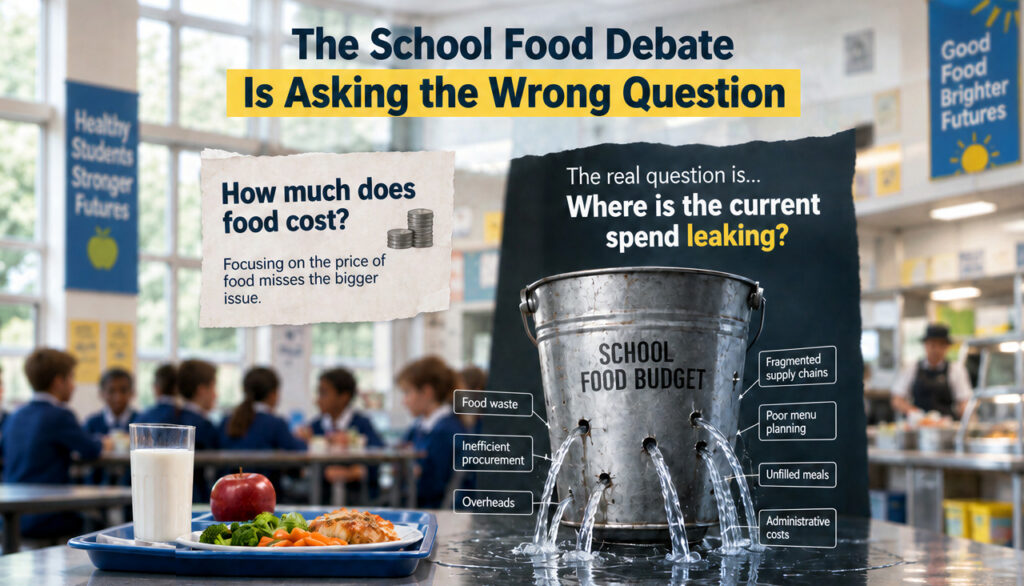
The biggest shake-up to school food in over a decade arrives in 2027. More fruit, vegetables, wholegrains and pulses. No deep-frying. Tighter limits on sugar and desserts. Breakfast clubs brought into nutritional scope for the first time. And all of it, the government says, to be delivered within existing budgets.
So the question doing the rounds is the obvious one: where’s the money coming from?
I think that’s the wrong question. The better one is: how much are you already losing?
The knee-jerk reaction writes itself. Fresh food costs more than processed. Get your forecasting wrong and waste climbs, especially as more children take up meals. WRAP puts school food waste in England at around 80,000 tonnes a year, costing an estimated £250 million and nearly half of it is fruit and vegetables, the very category these standards now demand more of. That’s real, and it’s the fear every operator is sitting with. But it’s only one way of looking at it.
Here’s what gets missed. The compliance conversation – nutrition, allergens, reformulation – is already in motion and rightly so. But two things are being quietly overlooked. The first is the money. The second is that the exact discipline being forced onto the plate applies just as hard to the pound.
Start with the plate, because it makes the point. Allergens cannot be tracked manually. Full stop. Fourteen regulated allergens, recipes that change, suppliers that swap an ingredient without telling you, the same dish served across a dozen sites – no spreadsheet survives contact with that. And nutrition isn’t an exact science either. Outside a static menu backed by lab analysis, the standards are a guide, not a guarantee; what’s written in the recipe and what lands on the tray are rarely the same thing. Which is the whole point: if you accept that allergens and nutrition need proper systems to be traceable, you’ve already accepted the principle. Money is no different.
So let’s put a model to it.
Take an operation with £1m of annual food and supplies spend. Suppose the shift to fresh adds somewhere between 5% and 10% to the ingredient bill – call it £50,000 to £100,000 a year. Frightening, in isolation.
Now look at the other side of the ledger. In the operations we analyse, somewhere between 5% and 8% of supplier spend turns out to be quietly recoverable – money leaking through price rises above the historical norm, gradual price drift, credits promised but never raised, duplicate payment destinations, off-contract buying and stock that spoiled. On £1m of food and supplies spend, that’s £50,000 to £80,000. How much depends entirely on how tightly the operation is already run – the looser the grip today, the more there is to find. In one operation we analysed, the recoverable value came to the mid-single digits of its supplier spend, and the bulk of it was hard cash rather than theory: overcharges challenged with evidence, duplicate payments stopped, missing credits chased down. Money that was already theirs, simply invisible.
Line those two up. For a broad range of assumptions, the money you’re already losing is the same order of magnitude as the cost of the upgrade. Recover toward the top of that range and you fund a mid-sized fresh-food premium outright. Even at the conservative end, you cover a good half of even a steep increase. The uncomfortable truth is that for a lot of operators, a large part of the upgrade is already funded – they’re unknowingly losing the money to disconnects, not carelessness.
And at scale, a second lever appears. Everything so far is leakage recovery – money you lose every year, whatever your size. But a multi-academy trust or local authority caterer running £10m and up isn’t only recovering £500,000 to £800,000 of that at the same rate; it has buying power a single kitchen can never touch. Once you can see fragmented spend across every site as one picture, volume purchasing lands on top – better rates, negotiated once and applied everywhere. So the savings don’t scale evenly down to the smallest operation; if anything, the maths tilts in favour of whoever is big enough and joined-up enough, to buy at volume. At that size, the total dwarfs the fresh-food premium and would embarrass most improvement budgets.
The catch is that none of this leakage announces itself, because most of it hides below the line. In one operation, more than nine in ten invoices arrived as a header total with no product breakdown at all – and you cannot challenge a price rise you cannot see, any more than you can evidence an allergen you never recorded. There’s no paperwork for a price that crept up 4% between deliveries. No explanation for a credit that was promised and never arrived. No line in the accounts for the case of stock that spoiled. It drains in silence, precisely because there’s no traceability and what you can’t trace, you can’t stop. It’s no different from an allergen. The regulation is about to force traceability onto the food. The operators who come out ahead will be the ones who hold the money to the same standard. Surfacing that leakage and acting on it, not producing another report to analyse, but the issue found and closed is the whole reason we’re building OmniPATH.
Yes, there’s the buying-power answer: renegotiate contracts, consolidate suppliers, sharpen the tender. It was floated again this week, and it isn’t wrong. But it’s time and effort demanded of live operations, and it’s future-tense, it plans for 2027 while the leakage is happening today, inside your own four walls, whatever your contracts say.
And there’s a problem sitting underneath the contracts. Nick Ryan of Dux Solutions put it to me sharply: in most schools, the buying decisions are made by people set up to fail at them. “We still allow Catering Managers to make choices and negotiate product/price, yet in most cases, they lack the data or commercial market view necessary for these decisions.” He continues that education, more than any sector, lacks procurement insight and that far too much of what’s bought is driven by the supply partner. His conclusion lands where mine does, from the other direction: “Until they embrace disciplined purchasing, systems and a commercial process they are wasting millions. Good food is available within the same budgets.”
None of this is an argument against the standards. It’s right that government, parents, teachers and pupils want the food to be better and the ambition is a good one. But be clear-eyed about the funding: the new money is broadening free meals to more children, not lifting the budget on the meals already served. The per-plate maths doesn’t improve. Which puts the responsibility somewhere uncomfortable but useful, with the operator and with how honestly they can see their own operation.
So before the question becomes “how will this be funded?”, or worse, “we can’t afford it”, do one piece of work first. Put a real number on what 5% to 8% of your food and supplies spend comes to. Then weigh that against the cost of feeding children fresh food. For more operations than you’d think, the second number is the smaller one. There are options here, and a degree of operational change may be all it takes to swing the balance of the books.
The money to feed children better may already be in your budget. It’s just leaking out of the bottom of it, in silence, because nobody’s tracing it. Fix that and the debate changes entirely.
How much can you see moving through your operation right now and how much would you find if you looked properly?